




Special Collections:
The Economy

Sir Mark Moody Stuart, a member of the Foundation for the Global Compact and the International Integrated Reporting Committee (IIRC), was interviewed in Beijing in January 2011.
He discussed the vital importance of Integrated Reporting in today's business environment. The interview also covered the crucial next steps required to ensure its continued success.

In February 2012, Jonathon Porritt, CBE, Chancellor of Keele University, delivered a public lecture.
His address focused on "Sustainability and The Future of Capitalism."

L. Hunter Lovins, President and founder of Natural Capitalism Solutions (NCS), discusses the business case for sustainability and the vital role of entrepreneurs. This presentation was part of a TEDx San Joaquin event.
NCS educates senior decision-makers across business, government, and civil society. Its mission is to restore and enhance natural and human capital, thereby increasing prosperity and quality of life. Lovins is also the author of *The Way Out*.

In his speech "What is Value?", Rory Sutherland argues that numbers hold little significance. He contends that poor or "atrocious" numbers actively undermine true value.
His bio is available here.

Adopting environmental and social sustainability principles enhances performance, with an ESG (Environmental, Social, and Governance) corporate culture fostering long-term success. This is detailed in research by Harvard Business School's George Serafeim, co-authored with Robert G. Eccles (Harvard Business School) and Ioannis Ioannou (London Business School).
Their paper, "The Impact of a Corporate Culture of Sustainability on Corporate Behavior and Performance," highlights these benefits. Download the working paper. Courtesy of FS Insight and Holland Financial Centre.
Hazel Henderson is a futurist, columnist, and world-renowned expert on sustainable development. She is the author of *Ethical Markets: Growing the Green Economy*.
This presentation features Henderson discussing quality of life indicators, incorporating feedback from the audience.

Deirdre Kent, co-founder of the New Economics Party in New Zealand, outlines specific recommendations for transforming our economic system into a sustainable one.
For more information and ideas on their proposals, visit the New Economics Party website.

David Korten, author of "Agenda for a New Economy," presented at the 39th Trinity Institute National Theological Conference. His address explored "Radical Abundance: A Theology of Sustainability."
Learn more about David Korten at davidkorten.org. His book, "Agenda for a New Economy," can be ordered from Amazon.com.

Joseph Stiglitz, a Nobel laureate in economics, discusses Occupy Wall Street.
Stiglitz graduated from Amherst College and earned his Ph.D. from MIT, becoming a full professor at Yale in 1970. His extensive teaching career includes Princeton, Stanford, MIT, and Oxford, where he was Drummond Professor. He received the Nobel Prize for his analyses of markets with asymmetric information.
He is currently a University Professor at Columbia University and Co-Chair of its Committee on Global Thought.

Riane Eisler, a social scientist, attorney, and author, has profoundly influenced cultural transformation. A leader in peace, sustainability, and economic equity, her pioneering human rights work expanded the focus of international organizations to include women's and children's rights.
Her newest book, The Real Wealth of Nations: Creating a Caring Economics, proposes a new economic approach. It gives visibility and value to the essential work of caring for people and nature.

Richard Wolff, an economist and Professor Emeritus at the University of Massachusetts, Amherst, addresses the current economic crisis. His speech delves into its roots and proposes potential solutions.
This presentation was filmed by Paul Hubbard at Brown University, Providence, RI, on December 2, 2009.

Newscaster Jon Snow interviewed Dame Ellen MacArthur about the circular economy and the first year of the Ellen MacArthur Foundation. Snow challenged the Foundation's mission to inspire a generation to rethink and redesign for a positive future, questioning the circular economy's implementation and impact on business.
Drawing on over five years of research, Dame Ellen made a strong case for the circular economy. She emphasized it as a distinct, sustainable business model crucial for ensuring a viable long-term future.
Professor Jeffrey Sachs of Columbia University delivered a lecture titled "The Future of Globalization" on December 10, 2007.
This event was presented as part of the "Conceptual Foundations of International Politics" course at the School of International and Public Affairs.

This film trailer features thought leaders from diverse fields addressing the myth of perpetual growth. The full film premieres on November 2nd.
Order your copy today to organize screenings starting in November. For more details and to order, visit GrowthBusters.org.

Discussions addressed critical global economic issues: macroeconomic imbalances, currency instability, global governance (G20), and the international financial system.
Key participants included Montek Singh Ahluwalia, Robert E. Diamond Jr., Christine Lagarde, George Osborne, Wolfgang Schäuble, Yu Yongding, and Robert B. Zoellick. The session was chaired by Martin Wolf, Associate Editor and Chief Economics Commentator for the Financial Times.

There's a significant opportunity to rethink and redesign how we make things. The "Re-Thinking Progress" initiative explores how a change in perspective can transform our economy, enabling us to design products "made to be made again" and power systems with renewable energy. This approach aims to build a creative, innovative, and restorative economy.
Discover more about the circular economy and its economic and business rationale through the Ellen MacArthur Foundation. Explore their "Towards the Circular Economy" reports and follow them on Twitter for further insights.

Nobel laureate Michael Spence spoke to Googlers on May 24, 2011, about his book, *The Next Convergence: The Future of Economic Growth in a Multispeed World*.
The book is expected to spark debate on post-crisis economic recovery, addressing the balance between national and international interests, and short-term fixes versus long-term sustainability. Order it from Amazon.
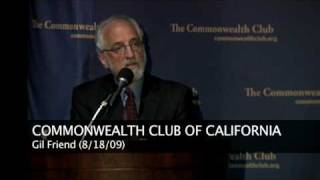
Many believe profitable businesses cannot also be environmentally and socially responsible. However, Gil Friend asserts that green business practices benefit both companies and the world, extending beyond mere shareholder value and profit.
Friend, Founder/CEO of Natural Logic, Inc., is the author of The Truth About Green Business.

The standard Triple Bottom Line (TBL) of Planet, People, and Profit often overlooks equity, viewing people as consumers rather than citizens. Julia Anastasio, Director of Sustainability for the American Public Works Association (APWA), emphasizes social sustainability, community well-being, and the vital role of public works.
Anastasio shared these insights during an interview with Ruth Ann Barrett of Earthsayers.tv at the APWA Sustainability in Public Works Conference, held June 27-29 in Portland, Oregon.
Richard Heinberg, a senior fellow at the Post Carbon Institute and author of "The Party's Over," "Peak Everything," and "Blackout," discusses the phenomenon of peak oil and its global implications.
He explains that the era of easily accessible resources is over. The new reality of expensive oil will likely become the norm, potentially leading to economic recession.
Environmental Scientist and Advocate
What EarthSayers stands for
Discover Diverse Voices on EarthSayers
Unlike algorithm-driven platforms that push you into a content bubble, we ensure you hear a variety of perspectives from scientists, activists, Indigenous leaders, business innovators, and everyday citizens working toward sustainability.
EarthSayers CINEMA
Watch, learn and lead—sustainability starts with you.
How to Live on Earth | Feature Documentary | Presented by Benedict Cumberbatch
What if the solutions to building a better future already exist? How to Live on Earth is an ambitious documentary that explores how humanity can create a thriving future by collaborating with nature. Presented by Benedict Cumberbatch, the film reveals the potential of teaming up with nature to address our greatest challenges.
Heartwarming and energizing, it offers a hopeful vision for a future where both nature and humanity can thrive. How to Live on Earth is produced by Open Planet Studios in association with Villars Institute Foundation and Silvania. Join the conversation by downloading film assets and sharing your reaction at howtoliveonearth.net/social-toolkit. Explore educational resources from the Villars Institute at YouTube.


