



Special Collections:
The Economy

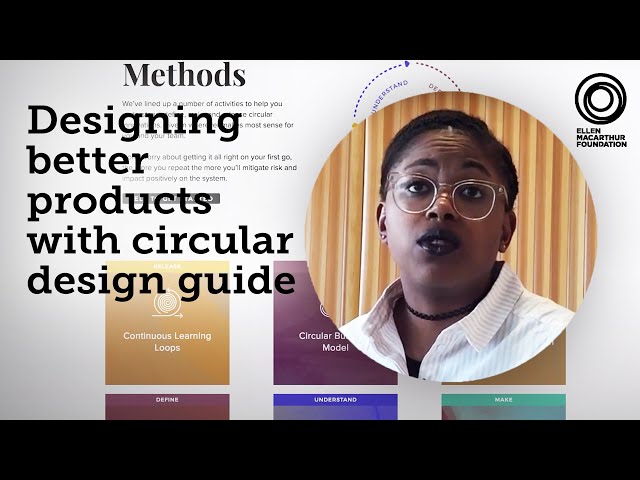
This video collection features academics and students sharing their insights into circular design and demonstrating their use of the Circular Design Guide. These resources aim to inspire other educators to integrate circular design into their curricula.
The Circular Design Guide is a free online tool offering 24 downloadable methods and resources for applying circular design principles. Explore it at circulardesignguide.com.

This video collection features academics and students sharing their insights on circular design and demonstrating their use of the Circular Design Guide. These resources aim to inspire other educators to integrate circular design principles into their curricula.
The Circular Design Guide is a free online tool, offering 24 downloadable methods, case studies, and resources for applying circular design. Explore this comprehensive guide at circulardesignguide.com.

Ellen MacArthur and Stella McCartney co-hosted the launch of the Ellen MacArthur Foundation’s report, "A new textiles economy: Redesigning fashion's future." The report urges the fashion industry to adopt a new vision and foster cross-industry collaborations to achieve it.
The current "take-make-dispose" model causes significant environmental damage and economic loss. Every second, a garbage truck of textiles is landfilled or burned, resulting in an estimated USD 500 billion loss annually. By 2050, the industry could consume a quarter of the world's carbon budget. Additionally, it pollutes oceans with half a million tonnes of microfibres yearly, impacting food chains.


Relive the most impactful moments from the 2017 Summit.
Our curated highlights package offers a concise overview of the key discussions and presentations.
Watch all the essential recaps now.

The current economic system, driven by growth and profit, depletes resources and exacerbates inequality. Sustainable Human proposes a new path: a voluntary global gift economy designed to foster abundance for all by transcending scarcity economics.
This initiative invites individuals to share their unique gifts and skills, collaborating on projects to create goods and services given freely. Powered by Hylo, the Sustainable Human Gift Economy Network aims to build a bottom-up, participatory system, reducing reliance on the traditional industrial economy. Learn more and participate at sustainablehuman.com.

Environmental and economic problems like low wages and unemployment are often blamed on a hard-to-regulate U.S. economy. However, this system is intentionally rigged for the wealthy. Laws and policies overwhelmingly favor them, allowing control of vast resources and lavish living, while most Americans struggle paycheck to paycheck.
Despite ample resources, our economic system is designed for the wealthy, who manipulate it via political influence. It could easily be regulated to ensure decent jobs, healthcare, and homes for all. Yet, we largely complain without taking action.

Consumers bear responsibility for the entire product lifecycle, from resource extraction and manufacturing to eventual disposal. Despite holding admirable sustainability values, our purchasing behaviors often fail to align, impeding progress in environmental, social, and economic sustainability. Individual actions form the foundation for meaningful change.
For more insights, see Part One: https://www.youtube.com/watch?v=2TFWbpgCFjg
By Kat McDearis and Eric Pappas. Copyright 2015.

Explore the principles of biomimetic design in Michael Pawlyn's chapter, featured in the Ellen MacArthur Foundation's latest publication: "A New Dynamic 2: Effective systems in a circular economy."
Order your copy of "A New Dynamic 2" here: tiny.cc/newdynamic2.
Learn more about the Ellen MacArthur Foundation: ellenmacarthurfoundation.org.

Join us for DIF 2014.
Register for your free pass at thinkdif.co/me.

The Schools and Colleges team interviewed UWC SEA students in Singapore. These students evolved from up-cycling plastic bags to embracing regenerative design, ultimately establishing a circular consultancy. They share insights into their journey and the consultancy's mission.
Learn more about our work in schools: Ellen MacArthur Foundation - Schools & Colleges.
We invite you to share your systems thinking or circular economy education story with us.

Students from UWC SEA in Singapore, who evolved from up-cycling plastic bags to regenerative design, share their insights. They offer ideas on how schools and institutions can foster learning for the circular economy.
Discover more about our educational initiatives and contribute your own systems thinking or circular economy story. Visit the Ellen MacArthur Foundation's Schools & Colleges program: https://www.ellenmacarthurfoundation.org/programmes/education/schools-colleges.
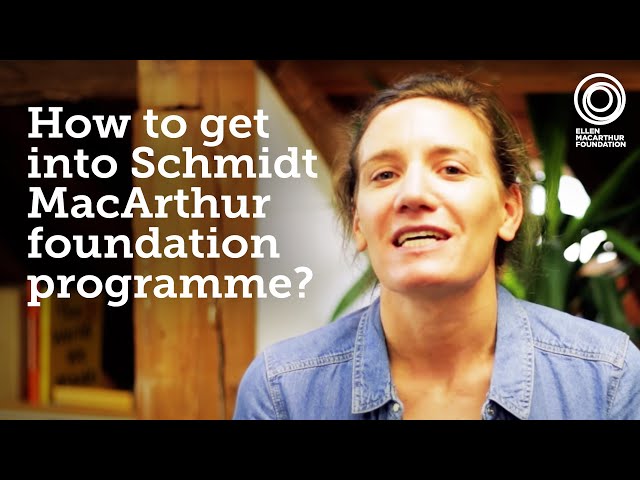
The Schmidt MacArthur Fellowship invites postgraduate and graduate students interested in the circular economy to apply. The submission deadline is February 12.
Find out more and submit your application on the Ellen MacArthur Foundation website: ellenmacarthurfoundation.org/programmes/education/schmidt-macarthur-fellowship.

The Schools and Colleges team interviewed UWC SEA students in Singapore. Initially up-cycling plastic bags, their work evolved towards regenerative design. These students now share their top five essential 21st-century skills for schools.
Learn more about our schools program here. We also invite you to share your systems thinking or circular economy education story with us.

The New Plastics Economy is a three-year initiative dedicated to building a functional plastics system.
Learn more about this project by visiting newplasticseconomy.org.
The animation was created by Simon Tibbs.
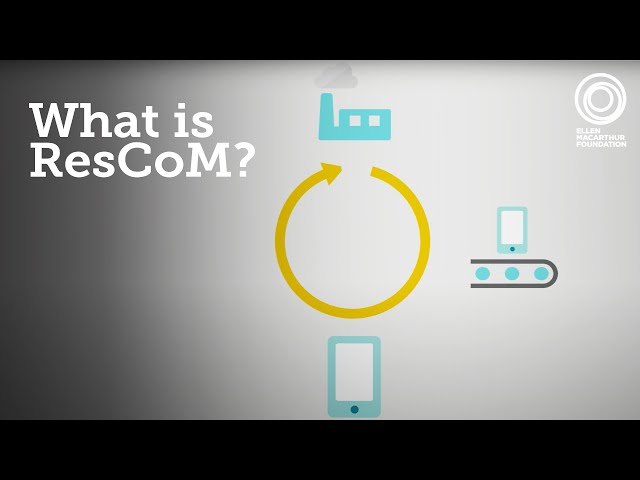
Discover ResCoM (Resource Conservative Manufacturing), a project developing an innovative methodology and software platform. Its aim is to implement closed-loop manufacturing systems within industry. Learn more at ResCoM website.
This project has received funding from the European Union’s Seventh Programme for research, technological development, and demonstration under grant agreement No 603843.
Hunter Lovins discusses soil and the circular economy in an engaging clip. Her insights are featured in the Ellen MacArthur Foundation's latest publication, "A New Dynamic 2: Effective systems in a circular economy."
Order your copy of the book: tiny.cc/newdynamic2
Learn more about the Ellen MacArthur Foundation: www.ellenmacarthurfoundation.org
Published on August 29, 2016, by Google Talks, this features Otto Scharmer. He is a Senior Lecturer at MIT, co-founder of the Presencing Institute and the Global Wellbeing Lab, and chairs the MIT IDEAS program.
Scharmer introduced the concept of "presencing"—learning from the emerging future—in his bestselling books *Theory U* and *Presence*.
To order his book, *Theory U*, visit Amazon or your local bookstore.

Economist and writer Christian Felber presents his "Economy for the Common Good" initiative. He explores whether businesses can achieve both endless growth and be fair and sustainable, and if an economic model untainted by our current financial system is possible. Learn more about Felber's work and his book Felber Book on Common Good.
Launched in 2010, the 'Economy for the Common Good' is now supported by over 2000 businesses across 40 countries. It aims to create systemic change by awarding legal benefit points to socially responsible companies, encouraging their pursuit of the common good. Felber demonstrates how this shift can be achieved, and his book "Change Everything" is available for purchase.
The RSA presented "The Inequality Debate" with Danny Dorling. This discussion explores whether London's economic success justifies growing inequality, and if the city can maintain economic efficiency amidst such disparities.
Watch Professor Dorling, from the University of Oxford, in the latest RSA Spotlight – an edited highlight of the event. For the full replay, click here.
Environmental Scientist and Advocate
What EarthSayers stands for
Discover Diverse Voices on EarthSayers
Unlike algorithm-driven platforms that push you into a content bubble, we ensure you hear a variety of perspectives from scientists, activists, Indigenous leaders, business innovators, and everyday citizens working toward sustainability.
EarthSayers CINEMA
Watch, learn and lead—sustainability starts with you.
How to Live on Earth | Feature Documentary | Presented by Benedict Cumberbatch
What if the solutions to building a better future already exist? How to Live on Earth is an ambitious documentary that explores how humanity can create a thriving future by collaborating with nature. Presented by Benedict Cumberbatch, the film reveals the potential of teaming up with nature to address our greatest challenges.
Heartwarming and energizing, it offers a hopeful vision for a future where both nature and humanity can thrive. How to Live on Earth is produced by Open Planet Studios in association with Villars Institute Foundation and Silvania. Join the conversation by downloading film assets and sharing your reaction at howtoliveonearth.net/social-toolkit. Explore educational resources from the Villars Institute at YouTube.


