




Special Collections:
Standing Rock Indian Reservation


In September 2016, the critical importance of sacred lands, exemplified by the Standing Rock movement, gained significant attention.
This movement underscored the vital link between protecting these lands and addressing climate change, emphasizing the need for responsible environmental stewardship.

Lynn Doan, a journalist with Bloomberg News, recently discussed the critical importance of journalistic objectivity.
Her insights focused on covering complex stories, specifically referencing challenges encountered when reporting on events such as Standing Rock.

L. Frank Manriquez, a Tongva-Acjachemen artist and activist, traveled to Standing Rock three times. She worked to protect the land surrounding the Dakota Access Pipeline and speaks out about health issues suffered due to the “DAPL Army’s” tactics.
Known professionally as L. Frank, she is also a writer, tribal scholar, and cartoonist. She lives and works in Santa Rosa, California.

On April 25th, 2017, Brenda White Bull, a lineal descendant of Lakota Chief Sitting Bull and Standing Rock Sioux Nation citizen, addressed the United Nations Permanent Forum on Indigenous Issues. She spoke powerfully about the state and personal violence perpetrated against Indigenous women and men during the Dakota Access pipeline resistance.
This critical intervention, filmed and edited by @IndigenousWomenMedia, called for global awareness and solidarity. Key messages included #IndigenousRising, #NoDAPL, #WaterisLife, and #StandWithStandingRock.

Water Protectors at the main resistance camp in North Dakota vowed continued resistance to the Dakota Access Pipeline (DAPL) as the camp was largely vacated following a Wednesday eviction order. The U.S. Army Corps of Engineers and North Dakota governor imposed a deadline, leading to around 10 arrests. Before the eviction, prayer ceremonies were held, and part of the camp was set on fire.
Protectors assert the camp sits on unceded Sioux territory under the 1851 Treaty of Fort Laramie. While most left, a couple dozen people remain. This encampment, once hosting over 10,000, was the largest gathering of Native Americans in decades. Construction on the final pipeline section resumed after the Trump administration granted an easement to drill beneath the Missouri River.

Published by The New York Times on February 23, 2017, "A Standing Rock Camp Is Burned" from "The Daily 360" reports on the clearing of the largest protest camp at Standing Rock. The evacuation, ordered by North Dakota's governor, took place on February 22, displacing occupants who had been on the land for months.
This story was reported by Nick Cote, Niko Koppel, and Kaitlyn Mullin. Read the full article here: http://nyti.ms/2kLF2Ix

Malcolm Fleschner of TYT Network interviews Michael A. Wood Jr. and Ashleigh Jennifer Parker.
Wood, a former Marine and Baltimore Police Officer, became a whistleblower on police violence. He also co-founded Veterans for Standing Rock, an effort to bring veterans to North Dakota to support water protectors. Parker serves as the PR coordinator for Veterans for Standing Rock.

Richard White, a lifelong resident of Standing Rock, discusses his profound relationship with the land and water, expressing deep fears for their future.
This piece, published on November 22, 2016, was created by KC McGinnis, Kaitlyn Mullin, and Maureen Towey.
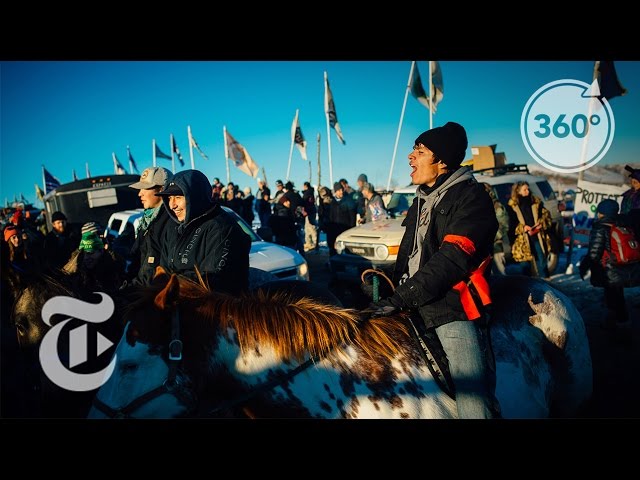
Published December 5, 2016.
This video features a drum circle at the Oceti Sakowin camp, filmed just after the Army announced it would explore alternative routes for the Dakota Access pipeline.
By Benjamin Norman, Niko Koppel, and Kaitlyn Mullin.

Grace Eagle Reed was interviewed on November 16, 2016, as part of a post-election Interfaith Call to Inclusion. She discussed her views on Standing Rock and the #noDAPL movement.
Born into Tsa La Gi culture, Grace was adopted by Lakota Grace Spotted Eagle and taught traditional ways.
This interview was produced and videotaped by Ruth Ann Barrett and Barry Heidt of EarthSayers.tv, Voices of Sustainability.

Native Americans fear the $3.7 billion Dakota Access Pipeline (DAPL), transporting crude oil from North Dakota to Illinois, threatens sacred lands and their Missouri River water supply.
At a camp near the Standing Rock Sioux reservation, protesters share their views on how Donald Trump's election might impact their campaign against the pipeline.
This report was published by The Guardian on November 14, 2016.

A revolution is unfolding at Standing Rock's Očhéthi Šakówiŋ camp, where over 200 indigenous American nations and 6,000 people have united in unprecedented solidarity. This movement, sparked by the fight against the Dakota Access Pipeline, aims to protect sacred water and assert tribal sovereignty against a colonialist state. In an era still celebrating Christopher Columbus, the indigenous rights movement is more vital than ever.
On Indigenous People's Day 2016, we stand with Standing Rock. Journalist Jonathan Klett connects events in North Dakota to D.C., while US Representative Candidate Chase Iron Eyes and Native Organizers Alliance director Judith LeBlanc discuss the stakes. Music is provided by Bethany Yarrow and Rufus Cappadocia. Learn more at lauraflanders.com.

Amidst numerous movements and tragedies, it's easy to feel overwhelmed. How do we stay accountable to our communities, question if "diversity" is enough, and avoid panic?
This week, celebrated journalist and author Jeff Chang addresses these concerns. He offers a message of hope: we can navigate these challenges and be alright, provided we work together.

On September 26, 2016, Standing Rock Youth and Chairman Archambault addressed President Obama at the White House Tribal Nations Conference in Washington D.C.
This video footage, published on October 6, 2016, was filmed and edited by ICTMN's Vincent Schilling, with assistance from Alex Hamer.

Lyla June wrote and performed this song, protesting #NpDAPL.
Motion graphics were created by Danica D'Souza. This content was published on September 30, 2016.

This field report from the Očhéthi Šakówiŋ (Seven Council Fires Community) at Standing Rock, North Dakota, details how over 200 nations defend their right to clean water and sovereignty against illegal land seizure. These protectors highlight a long struggle against environmental racism and genocidal erasure, showcasing the egalitarian actions of Standing Rock and Red Warrior Camps.
The report features indigenous leaders like Kandi Mossett, Phyllis Young, Cody Hall, Michelle Cook, and Terrell Iron Shell. As one leader states, "We've been here. We know how to take care of the land. Just listen to us." For more information, visit nativeorganizing.org or ienearth.org. Support this coverage at lauraflanders.com/join.
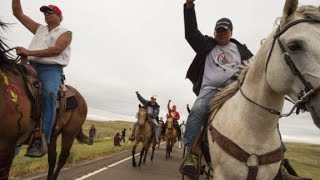
The Dakota Access oil pipeline generated considerable controversy in North Dakota.
Published on September 9, 2016, this brief CNN review covers the core issues and related demonstrations.

President Obama addressed inquiries regarding the North Dakota Pipeline.
These questions arose on September 9, 2016, during his visit to Laos.

Published on September 12, 2016, Democracy Now covered the Standing Rock standoff, interviewing Winona LaDuke.
LaDuke, a longtime Native American activist and executive director of Honor the Earth, lives on Minnesota's White Earth Reservation. She previously led a successful fight against the Sandpiper pipeline, which was similar to the Dakota Access project.
The interview took place at Red Warrior Camp, one of the encampments where thousands of Native Americans from hundreds of tribes across the U.S. and Canada were resisting the pipeline's construction.

North Dakota Governor Jack Dalrymple activated the National Guard ahead of a ruling on the Standing Rock Sioux Tribe's lawsuit against the $3.8 billion Dakota Access pipeline. U.S. District Judge James Boasberg is set to rule on an injunction challenging the Army Corps of Engineers' permits, arguing violations of the National Historic Preservation Act.
Over 1,000 people from more than 100 Native American tribes have gathered near the Standing Rock Sioux Reservation to resist the pipeline's construction, marking the largest tribal unification in decades. An update is provided by Tara Houska, national campaigns director for Honor the Earth.
Democracy Now!, an independent global news program, covers this story and airs weekdays.
Environmental Scientist and Advocate
What EarthSayers stands for
Discover Diverse Voices on EarthSayers
Unlike algorithm-driven platforms that push you into a content bubble, we ensure you hear a variety of perspectives from scientists, activists, Indigenous leaders, business innovators, and everyday citizens working toward sustainability.
EarthSayers CINEMA
Watch, learn and lead—sustainability starts with you.
How to Live on Earth | Feature Documentary | Presented by Benedict Cumberbatch
What if the solutions to building a better future already exist? How to Live on Earth is an ambitious documentary that explores how humanity can create a thriving future by collaborating with nature. Presented by Benedict Cumberbatch, the film reveals the potential of teaming up with nature to address our greatest challenges.
Heartwarming and energizing, it offers a hopeful vision for a future where both nature and humanity can thrive. How to Live on Earth is produced by Open Planet Studios in association with Villars Institute Foundation and Silvania. Join the conversation by downloading film assets and sharing your reaction at howtoliveonearth.net/social-toolkit. Explore educational resources from the Villars Institute at YouTube.


