




Special Collections:
Renewable Energy & The Smart Grid

David Keith reviews the science and technology of solar geoengineering, examining its potential to reduce climate risks, associated new risks, and current uncertainties. He proposes integrating solar geoengineering into a comprehensive 4D climate policy, which includes emissions cuts, carbon removal, and adaptation.
A distinguished expert, David Keith is a Harvard Professor of Applied Physics and Public Policy. He founded Carbon Engineering, a company developing technology to capture CO2 for carbon-neutral fuels. Best known for his work on solar geoengineering, he led Harvard's Solar Geoengineering Research Program. He has authored over 200 academic publications and "A Case for Climate Engineering."
The session was moderated by Greg Bronevetsky.

Mike Barlow is a solar worker for Swinerton Renewable Energy, based in Florida.
Support the #SaveSolarJobs initiative and learn more about the industry at www.seia.org/trade.

We proudly partner with Greenpeace, Empowered by Light, and Solargrid to install solar power for our Munduruku allies in the Brazilian Amazon. The Munduruku are vital protectors of the Tapajós River, one of Brazil's last free-flowing Amazon tributaries, which is threatened by large dam projects.
These solar installations provide clean energy and powerfully demonstrate that massive dams are not the answer to our energy demands. Support the Munduruku and their fight for land rights by taking action: http://amazonwatch.org/landrightsnow.

Amory Lovins offers a vivid analogy for the evolution of electric vehicles: "Ford's and Edison's industry are getting together to eat Rockefeller's industry."
This statement suggests that the combined forces of manufacturing and innovation are displacing the fossil fuel industry as electric transportation advances.

Renewable energy sources are abundant and readily available. Given this potential, why do we continue to rely on fossil fuels?
This 2-minute animation explores how we can transition to a world powered entirely by 100% renewable energy.
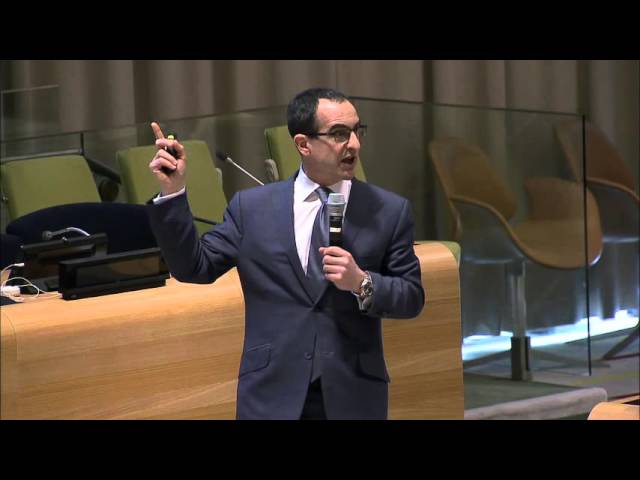
Ceres and Bloomberg New Energy Finance (BNEF) released "Mapping the Gap: The Road from Paris," a report exploring how to finance the global clean energy transition. Michael Liebreich (BNEF) presented its findings at the 2016 Investor Summit on Climate Risk at the U.N. headquarters in NYC.
The report reveals a significant $12.1 trillion global renewable energy investment opportunity in the electric sector over the next 25 years.
Download the full report and learn about Ceres' Clean Trillion initiative. Explore details on the Investor Summit on Climate Risk.

Former U.S. Energy Secretary Dr. Steven Chu, who oversaw a doubling of renewable energy deployment from 2009-2013, addresses if falling fossil fuel prices threaten wind and solar power.
Chu explains that 78% of U.S. economies have state-mandated renewable portfolio standards, requiring a fraction of clean energy. Renewables, currently supplying 13% of U.S. electricity, have seen significant cost reductions. Wind power, even without subsidies, is nearly as inexpensive as natural gas.
Solar generation in sunny regions nears cost parity with new natural gas plants. Wind and solar costs are projected to decline for decades, potentially making them competitive with any new energy source across much of the U.S. within a decade.

Christopher F. Jones's book redefines the fossil fuel revolution, focusing on advances in energy access—via canals, pipelines, and wires—rather than just production. He demonstrates how elaborate transportation networks for coal, oil, and electricity fueled remarkable urban and industrial growth in the American mid-Atlantic between 1820 and 1930, simultaneously setting the nation on a path toward fossil fuel dependence.
This historical account offers valuable lessons for pioneering a more sustainable energy future. To learn more, visit Christopher F. Jones's website or order his book from Amazon.
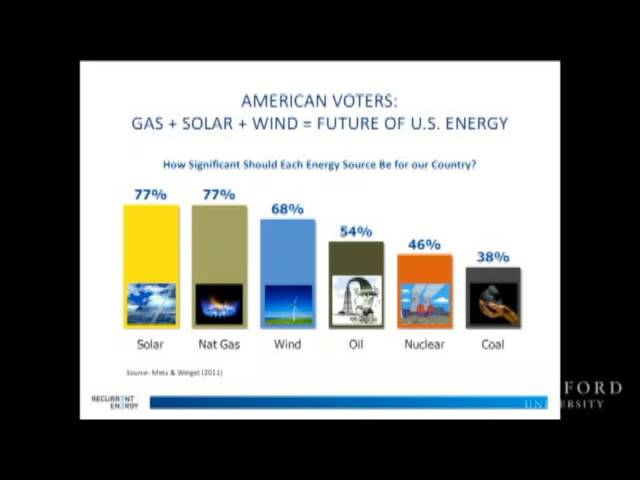
Arno Harris of Recurrent Energy delivered a seminar at Stanford University on January 7, 2013.
He discussed how solar industries, emerging from 2012, are poised to play a significant role in mainstream energy markets.

Anti-nuclear activist Dr. Helen Caldicott discusses renewable energy as an alternative to nuclear power. This content is excerpted from her talk at The Sanctuary for Independent Media in Troy, NY, on November 13, 2010.
Learn more about Dr. Caldicott at helencaldicott.com.
The original material was uploaded on November 29, 2010.

Small solar home systems provide light and phone-charging to off-grid households, saving them money. However, high upfront costs often make these beneficial systems inaccessible.
UK-based Azuri developed a pay-as-you-go system, enabling households to pay for solar power via scratchcards, making it affordable. Its Indigo Box won an Ashden Award for championing practical, local energy solutions that cut carbon, protect the environment, reduce poverty, and improve lives.

Small islands often depend on expensive imported fuel for electricity. In Cape Verde, the public-private partnership Caboélica harnesses plentiful winds, reducing diesel imports and boosting energy security.
Caboélica is an Ashden Award winner. Ashden promotes practical, local energy solutions that cut carbon, protect the environment, reduce poverty, and improve lives.

Rocky Mountain Institute (RMI) documented the University of California, San Diego's (UCSD) microgrid, a leading example of a locally controlled electricity network interconnected with the larger grid. This system manages 42 megawatts of generating capacity, comprising a central cogeneration plant, solar photovoltaic installations, and a fuel cell utilizing natural gas reclaimed from a landfill.
RMI seeks to identify and amplify solutions capable of transforming the electricity system. Learn more about their work at http://www.rmi.org/electricity.

The "smart grid" is on its way. This animated guide from Scientific American explains its essential features.
For additional videos, visit their YouTube Channel.

Tzeporah Berman of Greenpeace describes the "Energy (R)evolution," asserting that current technology can dramatically reduce dirty energy. Her journey confirms this transition is not only possible and already underway but also affordable.
Berman concludes that stronger laws are essential to accelerate this shift towards sustainable energy.

Goldman Prize winner Ursula Sladek established Germany's first cooperatively-owned renewable power company. This initiative directly responded to the nation's expanded reliance on nuclear energy.
Learn more at http://www.goldmanprize.org/2011/europe.

Environmentalist and entrepreneur Paul Hawken, CEO of OneSun Solar, delivered a speech at the 2010 Skoll Awards for Social Entrepreneurship. He focused on pressing global environmental problems.
Hawken is also the former Executive Director of the global Wiser community, a social network for sustainability. Its vision emerged from his research for his book, *Blessed Unrest: How the Largest Movement in the World Came into Being, and Why No One Saw It Coming*.
Order *Blessed Unrest* from Amazon or find it at your local bookstore.
Scott Anderson, Senior Policy Advisor at the Environmental Defense Fund, is discussing Carbon Capture and Sequestration (CCS).
His insights cover this crucial technology's role in environmental policy.

On February 8, 2010, Will Steger and Terry Gips discussed the economic opportunities for clean energy solutions in Minnesota.
They emphasized the importance of strong carbon emission limits and questioned what factors are hindering progress in these vital areas.

Oregon aimed for 25% renewable energy use by 2020, establishing itself as a global hub for solar manufacturing.
SolarWorld in Hillsboro exemplifies this leadership. With over 2,700 employees, the company is recognized as one of the world's largest solar energy businesses.
- 1
- 2
Environmental Scientist and Advocate
What EarthSayers stands for
Discover Diverse Voices on EarthSayers
Unlike algorithm-driven platforms that push you into a content bubble, we ensure you hear a variety of perspectives from scientists, activists, Indigenous leaders, business innovators, and everyday citizens working toward sustainability.
EarthSayers CINEMA
Watch, learn and lead—sustainability starts with you.
How to Live on Earth | Feature Documentary | Presented by Benedict Cumberbatch
What if the solutions to building a better future already exist? How to Live on Earth is an ambitious documentary that explores how humanity can create a thriving future by collaborating with nature. Presented by Benedict Cumberbatch, the film reveals the potential of teaming up with nature to address our greatest challenges.
Heartwarming and energizing, it offers a hopeful vision for a future where both nature and humanity can thrive. How to Live on Earth is produced by Open Planet Studios in association with Villars Institute Foundation and Silvania. Join the conversation by downloading film assets and sharing your reaction at howtoliveonearth.net/social-toolkit. Explore educational resources from the Villars Institute at YouTube.


