




Special Collections:
Plastic in Our Oceans

This document explores a key issue, featuring a one-on-one interview with Audrey Choi, Chief Marketing and Sustainability Officer at Morgan Stanley.
Copyright © 2020 by 3BL Media/Client. All Rights Reserved.

Nate Liebenberg, co-founder of idiveblue.com, champions awareness regarding the severe impact of throwaway plastics. These pollutants devastate marine species, contaminate our precious waters, and ultimately endanger human well-being.
Join us for a crucial discussion on ocean conservation and discover how we can collectively safeguard these vital ecosystems.

In July 2020, The Pew Charitable Trusts and SYSTEMIQ, with partners including the Ellen MacArthur Foundation, released "Breaking the Plastic Wave." This robust study on ocean plastic pollution revealed that without action, plastic volume will double, ocean entry will almost triple, and ocean stocks will quadruple by 2040. This aligns with the Ellen MacArthur Foundation's 2016 warning of more plastic than fish in the ocean by 2050.
The study emphasizes that a circular economy for plastic is the sole solution to tackle waste and pollution at its source. This vision already unites over 850 organizations through the New Plastics Economy Global Commitment and Plastics Pact network. Learn more about the study here.

Dame Ellen MacArthur urges "bold and urgent action" to address plastic pollution. A 2020 study, "Breaking the Plastic Wave," by The Pew Charitable Trusts and SYSTEMIQ, reveals a grim forecast: without intervention, by 2040, plastic on the market will double, annual ocean entry will almost triple, and ocean stocks will quadruple. This echoes the Ellen MacArthur Foundation's 2016 warning of more plastic than fish by 2050.
The study confirms a circular economy for plastic is the only way to tackle waste at its source. This vision already unites over 850 organizations. Find out more here.
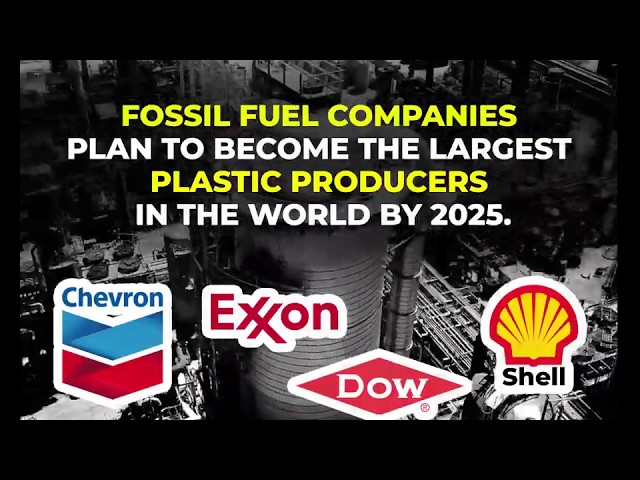
Fossil fuel companies are projected to become the world's largest plastic producers by 2025. This expansion will lead to a significant increase in plastic waste, further exacerbating air and water pollution.
Join the fight to stop plastic polluters and protect our environment: BiologicalDiversity.org/StopPlasticPolluters

Sir David Attenborough has shared an update from Blue Planet II regarding plastic consumption.
Born on 8 May 1926, Sir David Frederick Attenborough is an English broadcaster and natural historian. He is renowned for writing and presenting the BBC's "Life collection," a series of nine natural history documentaries that comprehensively survey Earth's animal and plant life.

"A Plastic Ocean" is an adventure documentary filmed over four years across more than 20 locations.
Explorers Craig Leeson and Tanya Streeter, with international scientists, reveal the causes and consequences of plastic pollution, offering solutions.

Addressing plastic pollution requires more than solutions like recycling, bioplastics, or compostable straws. These methods do not tackle the fundamental problem.
The only effective approach is to confront the root cause: halting the production of new plastic. This is the essential step for a lasting solution.

On August 14, 2019, Pakistan celebrated two independence days: its 72nd national freedom and the launch of a ban on single-use plastic bags. This initiative began with Islamabad's pilot project, making Pakistan one of 129 countries combating plastic pollution.
The World Bank is committed to Pakistan's environmental sustainability. Demonstrating this, the World Bank's Islamabad campus has operated free of single-use plastic for the past year, aligning with its pledge to "walk the talk."

Cigarette filters, often called the "last acceptable form of littering," are a major source of plastic pollution. Made from cellulose acetate, these filters release plastic, nicotine, heavy metals, and other toxic chemicals into waterways and oceans, posing a significant threat to our health and the planet.
National Geographic explores this critical issue and potential solutions. Learn more about this widespread plastic pollution by subscribing to National Geographic or reading "Cigarette butts are toxic plastic pollution. Should they be banned?" here.

The world's oceans are already drowning in plastic trash. Instead of stemming this pollution, plastic manufacturers aim to dramatically increase U.S. plastic production over the next decade.
Take action: https://biodiv.us/2K38a81

Discover solutions for a sustainable future from the 2019 Explorers Festival, where leading scientists and storytellers shared their insights. Watch a key discussion: Tracking Plastic Sea to Source.
National Geographic is your premier source for science, exploration, and adventure, delivering impactful stories through world-class experts.
Subscribe to our channel: NatGeoSubscribe. Find more content on our Official Site, Facebook, Twitter, and Instagram. Visit the main National Geographic YouTube channel.

Tackling plastic waste is a critical obstacle to achieving a circular economy. At the 2019 Pacific Summit, Kosi Latu, Deputy Director of SPREP, discussed the challenges facing the Pacific region and potential solutions.
The Ellen MacArthur Foundation, a UK charity launched in 2010 by world record-breaking sailor Ellen MacArthur, is a global thought leader accelerating the transition to a circular economy.
Learn more about their work at ellenmacarthurfoundation.org, subscribe to their YouTube channel, or connect on Instagram, Facebook, LinkedIn, Twitter, and Medium.

Ocean plastic is a solvable issue requiring personal responsibility and practical solutions. The Seabin Project, a crowdfunded invention, exemplifies a promising reactive approach. These bins effectively collect floating plastics, oil, and micro-plastics down to 2mm in marinas.
While Seabins are effective, they are not the ultimate solution. The project's 50% for-profit, 50% not-for-profit model supports education, science, research, and community engagement, which are considered the real long-term answers. This topic was discussed at a TEDx event; learn more at https://www.ted.com/tedx.

Baby sea turtles are dying due to ingested microplastics, highlighting an urgent environmental crisis.
You can help protect marine life. Take the pledge to #BreakFreeFromPlastic and make a difference: https://bit.ly/2UHjppR

Simon Bernard, Expedition Leader of Plastic Odyssey, presents the first round-the-world expedition on a boat powered solely by plastic waste. A graduate of the French Merchant Navy Academy, Simon is passionate about environmental solutions. He founded the Plastic Odyssey NGO to reduce ocean pollution by promoting plastic recycling solutions adapted for developing countries.
His talk will explore the mystery of missing plastic, challenging the "continent of plastic" myth. It will also discuss how open innovation can reduce plastic leakage and how we can all contribute to a circular economy. Connect online at @simn_bernard and @PlasticOdyssey.

Plastics are now found even in the deepest parts of our oceans, highlighting the pervasive nature of this pollution.
Join Oceana and the #BreakFreeFromPlastic movement to help address this critical issue: https://bit.ly/2FxAZYR.

Explore the remote Russian High Arctic with conservation biologist Joshua Powell in the new series, *Frozen Islands, Arctic Seas*. Powell delves into critical biodiversity issues facing the region.
This week, he highlights the threat of plastic waste, often mistaken for food by seabirds. New episodes air every Wednesday – subscribe now to follow his journey and insights.
Connect with Joshua Powell on Facebook and Instagram. Learn more about his work via National Geographic.

At Talks at Google, Peter Kohler (The Plastic Tide) and Dr. Stefan Leutenegger (Imperial College London) discuss the escalating ocean plastic crisis. They highlight how plastic threatens a vital $5 trillion economic resource and humanity's life support.
The Plastic Tide initiative quantifies this problem using drone imagery and machine learning. Their work involves a vast drone imagery database and a deep-learning algorithm for plastic detection and geo-referenced mapping.
The speakers will present early results, related research, and future strategies to limit ocean plastic. Learn more about their efforts at The Plastic Tide.

Artist Dianna Cohen reveals the harsh truths of plastic pollution, impacting our oceans and daily lives. She also offers insights on how to break free from the plastic gyre.
Learn more at the Plastic Pollution Coalition.
Environmental Scientist and Advocate
What EarthSayers stands for
Discover Diverse Voices on EarthSayers
Unlike algorithm-driven platforms that push you into a content bubble, we ensure you hear a variety of perspectives from scientists, activists, Indigenous leaders, business innovators, and everyday citizens working toward sustainability.
EarthSayers CINEMA
Watch, learn and lead—sustainability starts with you.
How to Live on Earth | Feature Documentary | Presented by Benedict Cumberbatch
What if the solutions to building a better future already exist? How to Live on Earth is an ambitious documentary that explores how humanity can create a thriving future by collaborating with nature. Presented by Benedict Cumberbatch, the film reveals the potential of teaming up with nature to address our greatest challenges.
Heartwarming and energizing, it offers a hopeful vision for a future where both nature and humanity can thrive. How to Live on Earth is produced by Open Planet Studios in association with Villars Institute Foundation and Silvania. Join the conversation by downloading film assets and sharing your reaction at howtoliveonearth.net/social-toolkit. Explore educational resources from the Villars Institute at YouTube.


