



Special Collections:
Oceans
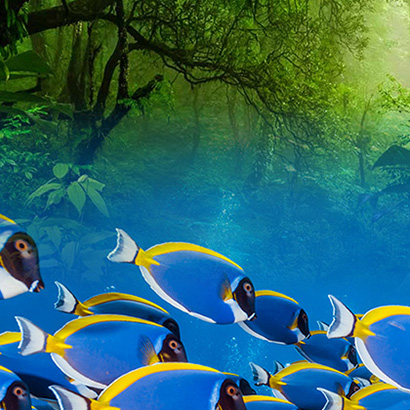

Identify the group to which each animal belongs.

Welcome to our identification quiz.
Test your knowledge: how many ocean animals can you recognize solely by their eyes?

Thanks to your invaluable support, Oceana secured significant victories for our oceans throughout 2024.
Your dedication as "Wavemakers" was absolutely critical in making these achievements possible.
Join us as we reflect on the collective impact we made this year.

Deep in the ocean, a variety of marine creatures are preparing for a substantial feast.
Driven by instinct, they await the perfect moment to satisfy their hunger with a significant meal.

Among various marine creatures often referred to as "jellys," a common misconception exists.
Can you identify which one, despite its appearance, is not truly a jellyfish?

Meet the "vampires" of the ocean! This intriguing moniker often refers to ancient, jawless fish like the lamprey, known for their unique and sometimes unsettling feeding habits.
These creatures attach themselves to other marine life, using their specialized mouths and sharp teeth to feed on blood and bodily fluids. Despite their parasitic nature, they hold a distinct and important place within aquatic ecosystems.

You wouldn't want to be a male anglerfish! Their existence is one of the most extreme examples of sexual parasitism in the animal kingdom.
Upon finding a female, the tiny male anglerfish bites into her, permanently fusing his body to hers. His circulatory system merges with hers, and he gradually degenerates, losing his eyes, fins, and most internal organs. He becomes little more than a sperm-producing appendage, sustained by the female, with his sole purpose being to fertilize her eggs when needed. It's a bizarre and ultimate sacrifice for reproduction.

Spooky season's festive spirit isn't confined to land. Its playful reach extends far beyond our shores.
Even the vast ocean embraces the Halloween fun, with its mysterious depths and unique, sometimes eerie, creatures.
From coastal waters to the deep blue, it seems everyone, and everything, gets into the spirit. p>

Moon jellies inhabit all oceans except the Arctic.
Subscribe to our channel and join our community of Wavemakers.
Connect with us on social media: [Instagram](https://www.instagram.com/oceana/), [Twitter](http://twitter.com/oceana), and [Facebook](https://www.facebook.com/oceana/).

Oceans profoundly impact our daily lives, and their health is vital for our planet and future.
Oceana campaigns globally to protect and restore these essential ecosystems.
Join us: OCEANA.ORG/JOIN

In June 2024, Amazon announced its commitment to fully remove plastic air pillows from delivery packaging in North America by the end of the year. This decision follows extensive campaigning by Oceana and its allies.
The company will replace these plastic fillers with 100% recycled paper, marking a significant step towards more sustainable packaging solutions.


Minke whales often engage in 'spy-hopping,' a behavior where they poke their heads above the water to observe their surroundings.
Join our community of Wavemakers! Subscribe to our channel and connect with us on [Instagram](https://www.instagram.com/oceana/), [Twitter](http://twitter.com/oceana), and [Facebook](https://www.facebook.com/oceana/).

In May, Oceana urged Coca-Cola Europacific Partners (CCEP), Coca-Cola's largest bottler, in London to reduce plastic use by increasing reusable packaging.
Support this initiative and join the #RefillAgain movement: https://oceana.ly/3LyVTZ6


Oceana and actor Dennis Haysbert invite you to champion our oceans.
Join a global wave of advocates making a difference today.

Nudibranchs, often called sea slugs, are captivating marine invertebrates known for their extraordinary beauty. These vibrant creatures display an astonishing array of colors and intricate patterns.
Beyond their stunning appearance, nudibranchs earn their "little thieves" moniker through remarkable predatory strategies. They steal defensive capabilities from their prey, a unique form of kleptoparasitism. For instance, some consume cnidarians, integrating stinging nematocysts into their own bodies for defense. Others practice kleptoplasty, incorporating algal chloroplasts for photosynthesis.
This blend of breathtaking aesthetics and ingenious survival tactics truly defines them as beautiful, thieving wonders of the ocean.

Penguin parenting is a remarkably demanding endeavor.
Raising chicks in often harsh, unpredictable environments presents numerous challenges, from securing food to protecting against predators. Both parents must exhibit remarkable dedication and resilience to ensure their offspring's survival.
Environmental Scientist and Advocate

