



Special Collections:
Wisdom Keepers


Amid global crises—climate change, ecocide, declining biodiversity, social inequity, injustice, and political turmoil—Indigenous lifeways and values offer a path to a better future. Core Indigenous values like relationship, responsibility, reciprocity, and redistribution guide us to be good stewards of our communities and ecosystems. Birds, our feathered relatives, provide valuable insights into these principles. Join the conversation.
Our panelists are Aimee Roberson (Cultural Survival Executive Director), Ruben Flores (CS Bazaar Artist), Kim Tekwitha Spencer (CS Youth Fellow), and Israel Hernández López (KOEF Grant Partner). Interpretation is available: tinyurl.com/lifeways1120.

Dr. Gregory Cajete, Director of Native American Studies at the University of New Mexico, explains that Indigenous physicists engage with the world through active participation, not just observation.
This approach involves their entire "sensual being," rooted in the native understanding that everything is "alive" with energy.

Dr. Leroy Little Bear presented a talk exploring the diverse conceptualizations and understandings of Indigenous Knowledge.
His discussion highlighted the varied perspectives and interpretations surrounding this vital subject.

Manari is a Sapara ceremonial leader and healing man, specializing in medicinal plants like natural tobacco. Through dream interpretation and spiritual connections, he offers natural, non-invasive cures for modern ailments, encouraging a rediscovery of our bond with nature.
As an indigenous rights advocate, Manari has successfully halted drilling efforts in his native territory and defended the Sapara community's rights at international human rights courts and the United Nations. He also manages NAKU, a communitarian enterprise providing ecotourism, healing alternatives, and natural medicine research rooted in indigenous cultural heritage. This talk was given at a TEDx event, independently organized by a local community. Learn more at ted.com/tedx.

Calling someone an "animal" often implies they are less than human, undeserving of respect or rights. Yet, biologically, humans are animals.
Scientists increasingly find intelligence and consciousness prevalent across nature. This understanding demands we rethink what it truly means to be an animal.
Visionary naturalist Carl Safina suggests that understanding other species begins with observation and humility.

Corrina Gould, Tribal Chair for the Confederated Villages of Lisjan Nation and a leading Indigenous activist, will discuss "Rematriation" at this year's conference. This practice involves reclaiming traditional land and sacred sites to rebuild cultures, heal colonial wounds, and prioritize women's unique role in this vital undertaking.
Gould co-founded Indian People Organizing for Change and the Sogorea Te’ Land Trust, an urban Indigenous women-led organization based in her ancestral territory (Oakland, CA). Through rematriation, cultural revitalization, and land restoration, the Land Trust calls on all people to heal and transform legacies of colonization.
This keynote was delivered at the 2024 Bioneers Conference. For more talks, visit Bioneers.

Yurok leader Sammy Gensaw III shares his experiences in ecological and cultural revival along the Klamath River. He discusses how ancestral wisdom, modern science, and activism were crucial for dam removal, highlighting Indigenous leadership’s role in rekindling connections to land and water for a resilient future.
Gensaw, a leader in environmental and cultural preservation, directs the Ancestral Guard, a nonprofit teaching traditional fishing and farming to Indigenous youth. His work, rooted in food sovereignty and community resilience, began with the Klamath Justice Coalition’s historic dam removal project. He is also featured in the documentary "Gather."
This keynote talk was delivered at the 2024 Bioneers Conference. Explore more talks: www.bioneers.org

A panel discussion, hosted by The Democracy Collaborative, explores integrating Indigenous wisdom into a "next system" to address economic and political crises. This new system would center life and nature, drawing from non-capitalist social and economic forms.
The panel features Freida Jacques (Turtle Clan Mother, Onondaga Nation), Jeff Corntassel (Cherokee Nation, University of Victoria), and Miki'ala Catalfano (Hawai'i resident, co-director of Native Roots Network). Stephanie Gutierrez (Oglala Sioux Tribe, founder of Hope Nation LLC) moderates, with Joe Guinan (President, The Democracy Collaborative) providing the introduction.

On March 1, 2024, a federal court ruled that a mining giant's proposed destruction of Oak Flat, an Apache holy site in Arizona, would not violate religious freedom laws. Apache Stronghold, supported by the Center, will appeal this 6-5 decision to the Supreme Court. The mine threatens Indigenous First Amendment rights, endangers species like ocelots, consumes vast water resources, and would generate 1.4 billion tons of toxic waste.
We urge you to help us call on Congress to pass a law preserving Oak Flat. Take action here: biodiv.us/49GFbRX. The Center for Biological Diversity, a 501c3 nonprofit, works to secure a future for all species by protecting vital lands, waters, and climate. For more information, visit becketlaw.org/case/apache-stronghold-v-united-states/.

Since 1960, Jane Goodall has been synonymous with wild chimpanzee study, conservation, and advocacy for hope. Her life experiences and the stories she shares are central to her identity, reflecting a scientific curiosity that began in childhood.
In an interview on "Dispatches from The Well," Jane discussed the significance of stories, recounting a childhood memory at age four. She patiently observed a hen laying an egg, an experience she views as foundational to becoming a scientist: asking questions, seeking answers, learning from mistakes, and developing patience.

We are thrilled to partner with Thousand Currents and 7th Generation Fund for a special edition of Native Pulse: Interwoven Voices.
Tune into this unique conversation featuring Haydee Sanches (Centro Cultural Techantit), Shelley Cabrera (Red Ñuqanchik Maronijei Noshaninka), and Berta Cumez (Asociación de Mujeres Ixpiyakok). Brenda Perez will moderate.
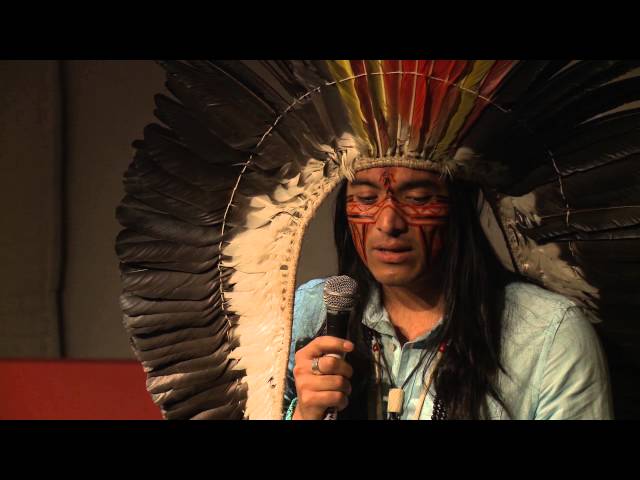
Nixiwaka Yawanawa, from the Yawanawa tribe, highlights our intrinsic connection with nature. He presented these insights at TEDxHackney.
Nixiwaka also delivered a second TED Talk, available here, further exploring his perspectives.

For millennia, Indigenous communities have been environmental guardians, using traditional knowledge to live in balance and protect flora and fauna. They safeguard 80% of the world's biodiversity, and protecting these lands and waters is crucial for climate mitigation, as these biodiverse areas are major carbon sinks. Indigenous peoples are the ancestral owners of nearly half the intact forest in the Amazon Basin.
Nemonte Nenquimo, a Waorani leader and co-founder of Ceibo Alliance and Amazon Frontlines, stresses that respecting Indigenous peoples' rights to their territories is vital for protecting the Amazon rainforest, our climate, and global life. Recognized by Time's 100 most influential people and a Goldman Environmental Prize winner, Nenquimo advocates against oil drilling on ancestral lands.
Learn more at Amazon Frontlines and explore more Bioneers videos.

ReGeneration embodies two concepts: regenerating life on Earth and a new human generation uniting to reverse global warming. Join environmentalist Paul Hawken, author of *Regeneration: Ending the Climate Crisis in One Generation*, as he presents an optimistic and joyful response to the climate crisis. Elizabeth Carney will moderate this event, held on November 3, 2021, inspiring attendees with a renewed sense of purpose.
The Commonwealth Club of California, founded in 1903, is the nation's oldest and largest public affairs forum. It hosts over 500 annual events, featuring diverse speakers from Teddy Roosevelt to Anthony Fauci, reaching millions through its programs and podcasts. Become a member: https://www.commonwealthclub.org/membership.
The Turtle Lodge and Manitoba First Nations Education Resource Centre (MFNERC) present Wahbanang: The Resurgence of our People – Clearing the Path for Our Survival. It commemorates the 50th Anniversary of Wahbung: Our Tomorrows.
Authored by Anishinaabe, Ininiwak (Cree), and Dakota Knowledge Keepers, Elders, and Chiefs, Wahbanang shares ancestral wisdom. It offers an urgent warning and a blueprint for all peoples to uphold the Great Binding Laws of the Creator and Mother Earth. Includes a video presentation.
Wahbanang, meaning 'Going Back to the beginning,' builds on the 1971 Wahbung, which asserted First Nations' inherent rights. It originated from a 2018 Assembly of Manitoba Chiefs (AMC) initiative at the Turtle Lodge. It is available for purchase here.

Grandmother Katherine Whitecloud teaches that addiction arises from unresolved trauma and disconnection from ancestral ways. Healing involves understanding our individual gifts and responsibilities, learned through ceremony with Elder and family support.
The Turtle Lodge International Centre, in partnership with Sagkeeng Mino Pimatiziwin, provides guidance for addiction recovery. Join us as we share Elders' messages on healing for a balanced life.
View our series playlist: YouTube Playlist. Learn more about Turtle Lodge's mission to reconnect with Earth and ancestral knowledge at www.turtlelodge.org, and follow us on social media.

In June 2021, economist Tim Jackson and Garrison Institute co-founder Jonathan F. P. Rose discussed envisioning a viable future. Their conversation explored the worldview and systemic changes necessary to address the root causes of climate change, social inequity, and financial instability.
They identified capitalism itself as the underlying issue. Jackson further explores this post-capitalist future in his forthcoming book, *Post Growth: Life After Capitalism*.

Anton Treuer explains the origin, function, and historical evolution of the Ojibwe clan system.
This presentation, delivered in English with some Ojibwe vocabulary, took place on March 28, 2021.

Debra Haaland was confirmed as U.S. Interior Secretary on March 15, 2021, making her the first Native American Cabinet secretary. She will oversee energy and climate policy on millions of acres of public land, alongside the Bureau of Indian Affairs.
PBS Newhour explored the significance of her appointment for Native Americans, featuring a discussion with Timothy Nuvangyaoma, chairman of the Hopi Tribe in Arizona.

Howard Zinn (1922-2010) delivered his talk, "The Myth of American Exceptionalism," at MIT on March 14, 2005. This was the inaugural lecture in the "Myths About America" series, organized by MIT's Special Program for Urban and Regional Studies (SPURS).
Zinn, a renowned historian, playwright, and self-described democratic socialist, is best known for "A People's History of the United States" (1980). He previously chaired the history and social sciences department at Spelman College and served as a political science professor at Boston University.
For more information, please visit the MIT Infinite History site.
Environmental Scientist and Advocate

