




Special Collections:
Transforming Our Economy

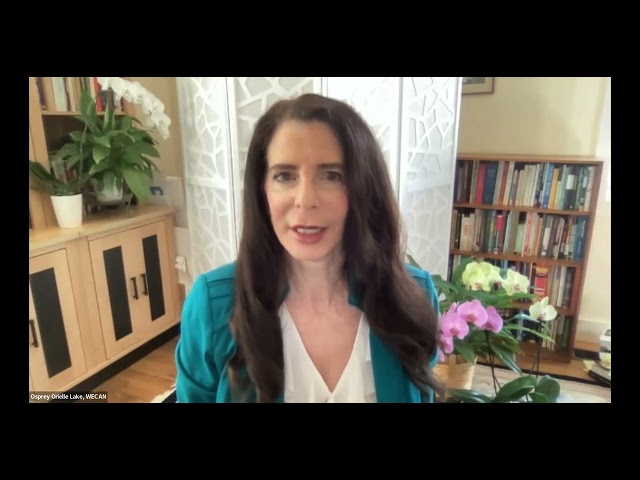
Indigenous women are leading global efforts to uphold Indigenous rights, sovereignty, and Free Prior and Informed Consent (FPIC) in interactions with financial institutions and corporations. These institutions often perpetuate human and Indigenous rights violations, particularly in extractive industries. A recent event highlighted the need for these entities to implement FPIC, Indigenous rights, and due diligence, while investing in climate justice solutions centered on Traditional Ecological Knowledge.
Given the climate crisis, respecting Indigenous knowledge, ways of life, and FPIC—including the right to say “no” to extraction—is paramount, as 80% of Earth's biodiversity remains on Indigenous lands. This discussion took place at a formal side-event of the United Nations Permanent Forum on Indigenous Issues 2022, featuring Indigenous women leaders and global advocates like Sônia Guajajara and Casey Camp-Horinek.
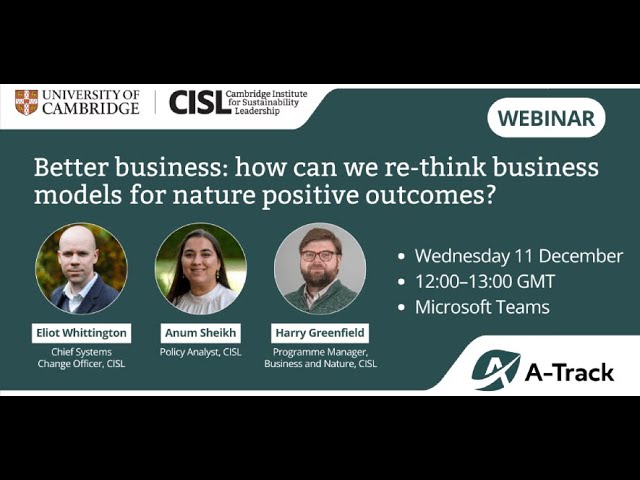
This CISL webinar explores the "Better business: Re-thinking business models for nature positive outcomes" report. Funded by UKRI and EU-Horizon as part of the A-Track project, it advocates for a systemic, transformational shift towards a nature-positive economy, moving beyond operational changes. The aim is to identify and scale profitable business models aligned with global nature goals.
Eliot Whittington discusses the work's broader policy context, while lead author Anum Sheikh presents key implications for business. Harry Greenfield details how businesses can engage in this three-year project through workshops, hackathons, and pilots, benefiting from CISL's innovation and advisory expertise.

The Pathways to Planetary Health initiative at the Garrison Institute hosted an online forum on June 24. Garrison Institute Co-founder Jonathan F.P. Rose joined Kate Raworth, Leonora Grcheva, and Erinch Sahan from Doughnut Economics Action Lab (DEAL) to explore Doughnut Economics. This framework defines the goal of economics as "social and ecological wellbeing rather than growth."
The discussion highlighted its global application. Kate Raworth introduced the concept, followed by Leonora Grcheva's insights on city implementation and Erinch Sahan's perspective on business applications. This insightful forum, reflecting the Garrison Institute's "Timeless Wisdom, Timely Action," offered ideas for improving the quality of life for all.

Peter Singer, author of "Famine, Affluence and Morality," discusses effective altruism and our moral obligation to help others. This philosophy focuses on raising minimum living standards, encouraging everyone—not just the wealthy—to contribute and find happiness in building a better world.
Singer outlines the movement's history, citing examples like Zell Kravinsky, who donated most of his wealth and a kidney. He stresses the importance of thorough research before donating to any cause, ensuring contributions achieve the greatest possible good.

Capital Institute founder John Fullerton discussed Regenerative Economics on April 1, 2020. He outlined how to achieve a just, sustainable way of living by aligning with living systems thinking.
For more information and to explore this discussion further, visit the Volans website: https://volans.com/tomorrows-capital-institute-john-fullerton/. You can also connect with Volans on Twitter (@VolansHQ), via email (info@volans.com), or by phone (+44 20 3701 7550).
Human-induced climate change and escalating environmental and social problems, including water scarcity, resource depletion, injustice, and inequity, pose significant global threats to human health and ecosystems.
Despite extensive global efforts, over one billion people remain in extreme poverty. Economic growth has largely excluded them and has come at the expense of our environment. Addressing these critical issues requires a concerted push for truly sustainable growth.

Ecological economics is crucial because the global economy depletes natural resources, yet traditional economic models often disregard its biophysical foundations. This perspective is highlighted by bio-ecologist and ecological economist William Rees in an INET interview.
Rees, Professor Emeritus at the University of British Columbia’s School of Community and Regional Planning, emphasizes the need for this approach.

Nobel laureate Richard Thaler and Cass R. Sunstein's "Nudge: The Final Edition" explores how to guide people toward better decisions without restricting their freedom of choice. The book highlights that individuals often make unwise choices due to inherent biases, and that choices are never presented neutrally. It advocates for helping people make optimal decisions for themselves, their families, and society.
Thaler, awarded the 2017 Nobel Memorial Prize for his contributions to behavioral economics, co-authored this work. Get the book here.

Richard Wolff's "Democracy at Work: Curing Capitalism" was presented at Talks at Google.
Wolff is Professor of Economics Emeritus at the University of Massachusetts, Amherst, where he taught from 1973 to 2008. He currently serves as a Visiting Professor in the Graduate Program in International Affairs at New School University in New York City.

Thanks for visiting GerdTube! Gerd Leonhard is a Futurist, Author, and Keynote Speaker based in Zürich, Switzerland. Explore his work further at his main website, futuristgerd.com, and learn about his latest book at techvshuman.com.
Audio-only versions of most videos are available on SoundCloud (soundcloud.com/gleonhard/tracks) and Spotify (gerd.fm/spotify). Follow Gerd on Twitter: @gleonhard.

This session was part of the two-day live Responsible Business Europe 2020 broadcast: https://www.reutersevents.com/events/rbs.
Speakers included David Grayson, Chairman of the IBE.

The "Future of Sustainability 2020" webinar, held on July 8, 2020, explored how the radical disruption of the COVID-19 crisis can drive a truly sustainable, just, and resilient future.
Forum for the Future believes reverting to "business-as-usual" would be tragic. This moment offers an unprecedented opportunity to reinvent the future, and they call on business, governments, civil society, and communities to seize it for a more just, sustainable, and resilient world.
The discussion featured Dr. Sally Uren, CEO of Forum for the Future, co-host Hannah Pathak, and other leading experts from organizations including Laudes Foundation, Innovate UK, Bettys and Taylors, and Unilever.

Daniel Magallon, featured at TEDxBasel June 2020, is a sustainable energy technology, finance, and market specialist. He focuses on utilizing pandemic recovery plans to tackle climate change, drawing on extensive project implementation experience across Europe, Asia, Latin America, and Africa.
Since 2007, Magallon has served as CEO of BASE, a Swiss organization dedicated to scaling investments in climate change solutions. His work develops market-based business models and financial mechanisms, including “Energy Savings Insurance,” “Financing RE through remittances,” “On-bill Financing,” and the “Cooling as a Service” model, recognized by the Global Innovation Lab in 2019.

This entry, part of the Employment Law 101 series by Ross Runkel, discusses the employment at-will doctrine. It covers its definition, operation, and key exceptions.
In U.S. labor law, at-will employment allows an employer to dismiss an employee for any non-illegal reason, without prior warning.

Adam Davidson, co-founder of NPR's Planet Money, explains how the economy evolved over the last two centuries, shifting from localized production to "intimacy at scale." This hybrid system, combining elements of the 19th and 20th centuries, presents both benefits and drawbacks.
Davidson, a staff writer at The New Yorker and former economics writer for The New York Times Magazine, is an award-winning journalist, having received a Peabody for his coverage of the financial crisis.
His latest book, *The Passion Economy: The New Rules for Thriving in the Twenty-First Century*, further explores these themes. You can find it here.

In a "Talks at Google" presentation, Dr. Avraham Arbib discussed the global economic downturn, attributing its origins to the overuse and misuse of natural resources. He argued that continuous growth is unsustainable, increasing the risk of a non-linear collapse.
Dr. Arbib emphasized the need to reduce consumption rates in developed nations, clarifying this isn't a disaster, as living standards are not inherently tied to consumption. Essential to global economic stability is a redistribution of wealth, income, and opportunities for growth.

The Federal Reserve Bank of St. Louis plays a key role in economic education.
Specifically, it explains Gross Domestic Product (GDP) and actively promotes its understanding and significance as a vital economic indicator.

In this Left Out episode from March 8, 2018, economist Stephanie Kelton debunks budget deficit and government spending myths. She explains how understanding our monetary system is crucial for advocating programs like universal healthcare, free higher education, and infrastructure investment.
A pioneer of Modern Monetary Theory (MMT), Kelton also explores current economic issues, including student debt cancellation and the challenges women face in economics. A Professor at Stony Brook University, she previously served as Chief Economist on the U.S. Senate Budget Committee and an advisor to the Bernie 2016 campaign.

As part of a lecture series by UCL Institute for Innovation and Public Purpose (IIPP) and the British Library, Stephanie Kelton, former Chief Economist on the US Senate Budget Committee, explained why a government budget differs fundamentally from a household budget.
Kelton offered a beginner’s guide to public deficits, questioning whether a balanced budget is the correct goal. She proposed a new understanding of deficits, debt, taxes, and the public-private sector relationship. Her vision advocates for a participatory, mission-oriented public budget to restructure services, investment, and build a cleaner, safer, more secure future for all.

Home Depot co-founder Ken Langone advocates for capitalism, asserting it as the optimal economic model. He champions the "rising tide lifts all boats" principle, acknowledging capitalism's downsides but highlighting its capacity to elevate individuals. Langone points to 3,000 Home Depot employees who started in entry-level positions and became millionaires.
Langone co-founded The Home Depot in 1978 with Arthur Blank, Bernard Marcus, Pat Farrah, and Ron Brill. The company has since grown into a multibillion-dollar enterprise. For further details, visit BigThink.com.
Environmental Scientist and Advocate
What EarthSayers stands for
Discover Diverse Voices on EarthSayers
Unlike algorithm-driven platforms that push you into a content bubble, we ensure you hear a variety of perspectives from scientists, activists, Indigenous leaders, business innovators, and everyday citizens working toward sustainability.
EarthSayers CINEMA
Watch, learn and lead—sustainability starts with you.
How to Live on Earth | Feature Documentary | Presented by Benedict Cumberbatch
What if the solutions to building a better future already exist? How to Live on Earth is an ambitious documentary that explores how humanity can create a thriving future by collaborating with nature. Presented by Benedict Cumberbatch, the film reveals the potential of teaming up with nature to address our greatest challenges.
Heartwarming and energizing, it offers a hopeful vision for a future where both nature and humanity can thrive. How to Live on Earth is produced by Open Planet Studios in association with Villars Institute Foundation and Silvania. Join the conversation by downloading film assets and sharing your reaction at howtoliveonearth.net/social-toolkit. Explore educational resources from the Villars Institute at YouTube.


